

A focus on systems & settings
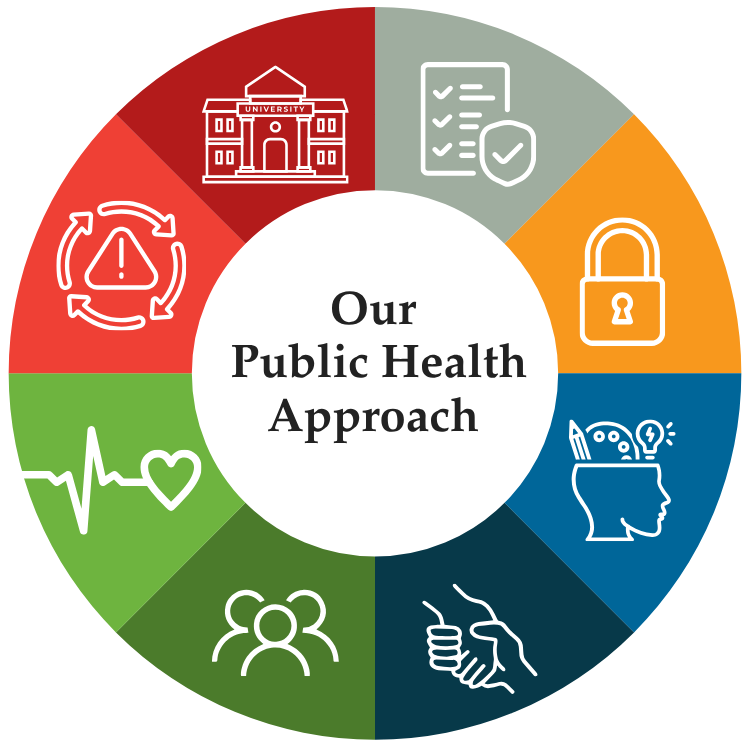
With leadership and coordination from the Skorton Center for Health Initiatives, Cornell University applies a comprehensive public health approach to complex college health challenges. The approach integrates multiple complementary dimensions that work together across campus systems, settings, and communities:
Institutional leadership for culture change | Policy & practice initiatives | Assessment of environmental risks & protective factors | Education & skills for well-being | Help-seeking & reporting | Identification of people in need of care | Timely & equitable access to support & clinical care | Coordinated incident response & accountability
How these dimensions are specifically applied varies by health topic. Explore how the following topics are currently being addressed by this approach in key initiatives:
- Alcohol & Other Drug (AOD) Misuse
- Hazing Prevention
- Mental Health Promotion & Suicide Prevention
- Sexual Violence Prevention
While this model and campus strategies have evolved over time, the underlying premise remains consistent: complex health challenges require coordinated action at multiple levels. Cornell therefore combines systems and environmental change with education, early identification, support, care, and services for individuals.
Cornell's public health approach has also informed Skorton Center research and scholarship, contributing to health promotion practice and collaboration at Cornell and beyond.
Examples of key efforts:

Visible, sustained leadership establishes health and well-being as an institutional priority and supports long-term culture change. Cross-campus collaboration, data-informed decision-making, shared responsibility, and ongoing assessment help align people, resources, and strategies toward common goals.
Examples include:
- Cross-campus coalitions, committees, and leadership structures that guide strategy and continuous improvement
- Campus and national data used to identify priorities, monitor trends, and inform action
- Health Promoting Campus commitments that advance shared responsibility for health and well-being

University policies, procedures, and institutional practices establish expectations, reduce risk, promote healthier and more equitable environments, and provide frameworks for prevention, support, response, and accountability.
Examples include:
- University policies and codes addressing student conduct, sexual misconduct, hazing, and AOD
- Cornell’s Good Samaritan Protocol, which encourages help-seeking during AOD-related emergencies
- Institutional reporting and transparency practices, including Annual Security Reports and hazing Transparency Reports well-being in all university policies and practices.

Physical, social, academic, and organizational environments can increase risk or protect health and well-being. Cornell assesses these conditions and applies strategies that reduce environmental risks while strengthening safety, connection, belonging, and other protective factors.
Examples include:
- Means-restriction strategies that reduce access to lethal means for suicide
- AOD-related event management practices designed to reduce risk in social environments
- Campus safety assessments, infrastructure, and practices that identify and address environmental risks

Evidence-informed education builds the knowledge, skills, and confidence people need to support their own well-being, make informed decisions, recognize concerns, respond effectively, and contribute to the health of others.
Examples include:
- Bystander education that builds skills for recognizing concerns and responding effectively
- Sexual violence prevention programs that strengthen skills related to relationships, consent, and bystander action
- AOD and hazing education that promotes harm reduction, healthy decision-making, and positive group practices

Clear, accessible pathways for seeking help, sharing concerns, and reporting incidents connect community members with appropriate resources and enable earlier intervention. Cornell also works to reduce barriers—including stigma, uncertainty, and lack of awareness—that may discourage people from reaching out.
Examples include:
- Centralized online resources that explain support services, reporting options, and how to help others
- Multiple pathways for reporting concerns related to hazing, sexual violence, and other forms of harm
- Communications and educational initiatives that normalize seeking help for oneself and others

Early identification can help connect individuals and communities with support before concerns become more serious. Cornell equips community members to recognize signs of distress or harm and provides mechanisms for referring individuals and groups for appropriate follow-up.
Examples include:
- Student of Concern referrals to Student Support and Advocacy Services (SSAS)
- Faculty, staff, residential staff, coaches, and peers trained to recognize concerns and connect to resources
- Screening, assessment, and other early-intervention practices identify students who may benefit from support

Accessible, coordinated services help ensure that community members can receive appropriate care and support when health concerns or harmful experiences occur. Campus and community partners work together to provide services responsive to individual circumstances, identities, and needs.
Examples include:
- Cornell Health’s collaborative medical and mental health services
- Confidential Victim/Survivor Advocates who provide trauma-informed support and assistance navigating option
- Campus and community partnerships that connect individuals with specialized services

Timely, coordinated response addresses urgent concerns, supports affected individuals and communities, and—when applicable—promotes accountability through university policies and legal requirements. Information learned through incidents and response can also inform future prevention efforts.
Examples include:
- Coordinated emergency and crisis response involving health, student support, and public safety partners
- Investigation and accountability processes for reports of hazing, sexual violence, and other prohibited conduct
- Transparent reporting of incidents, findings, and outcomes when required or appropriate
Alignment with Health Promoting Campus
Cornell's public health approach closely aligns with its commitment as a Health Promoting Campus to embed health and well-being throughout university culture and across administrative, operational, and academic practices. Both frameworks recognize that health is shaped not only by individual choices and behaviors, but also by the policies, environments, relationships, systems, and social conditions that surround us.
Together, they emphasize creating conditions that support health and well-being while building the knowledge, skills, resources, and systems needed to address specific health challenges.
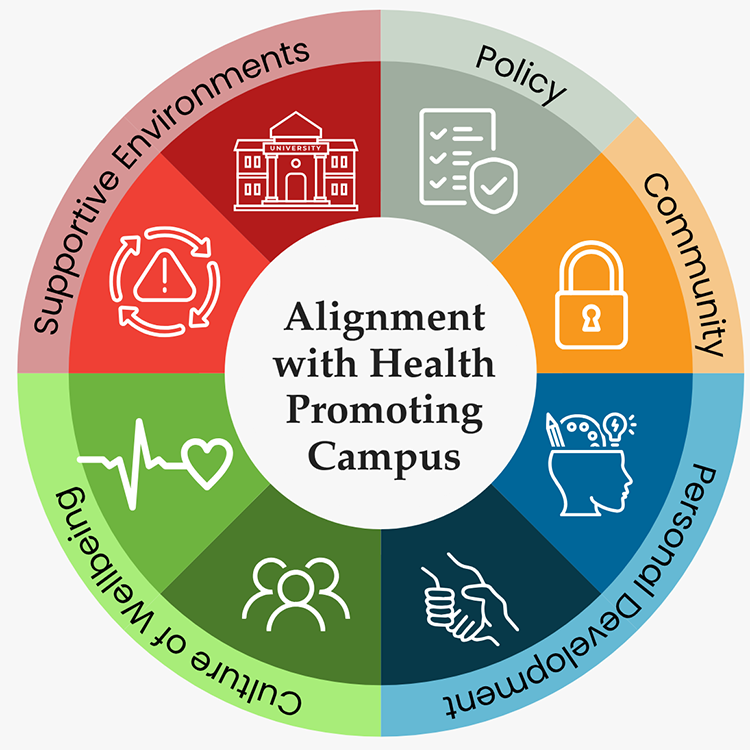
While there is not a direct one-to-one correspondence, five key dimensions of a Health Promoting Campus approach closely align with and reinforce the eight dimensions of Cornell’s public health approach.:
- Supportive Environments
- Policy
- Community
- Personal Development
- Culture of Wellbeing
This flyer (CU NetID required) provides further illustration of how the frameworks intersect.
More information
Please contact the Skorton Center for Health Initiatives at Cornell Health.