


Approach
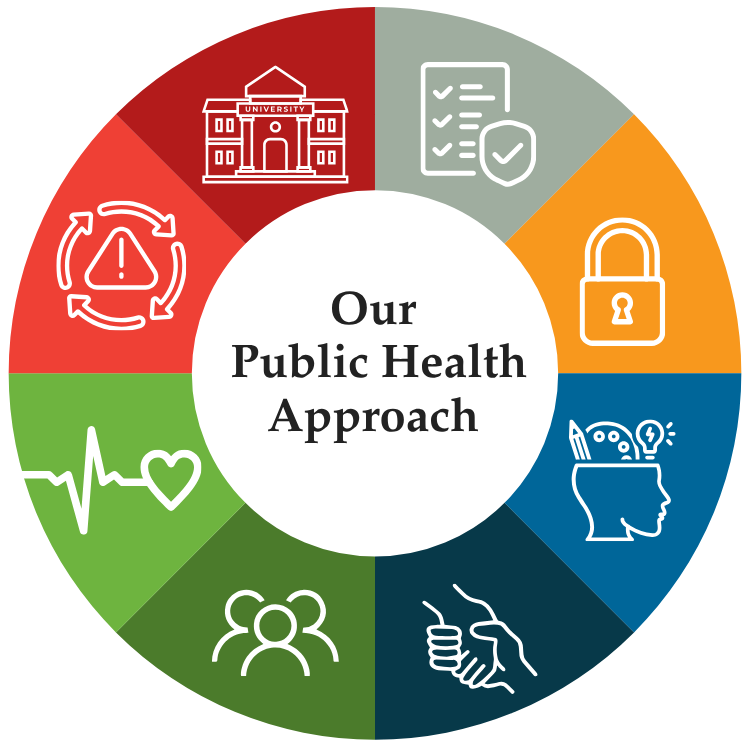
Our approach
For more than a decade, with leadership from the Skorton Center for Health Initiatives, Cornell has cultivated a culture of collective responsibility for the prevention of alcohol and other drug (AOD) misuse. Our data show most students either abstain from alcohol or drink moderately, with half of undergraduates reporting they don’t drink at all. Even fewer students report using other drugs. Still, alcohol and other drug (AOD) use contributes to serious harm for some students, affecting academic success, personal well-being, and campus health.
Cornell addresses AOD use through a comprehensive public health approach integrated with mental health, sexual violence prevention, and hazing prevention. Below are some of the key services, programs, policies, and other initiatives that prevent or reduce AOD-related harms as represented across the following eight categories:
Institutional leadership for culture change | Policy & practice initiatives | Assessment of environmental risks & protective factors | Education & skills for well-being | Help-seeking & reporting | Identification of people in need of care | Timely & equitable access to support & clinical care | Coordinated incident response & accountability
Because AOD use exists along a continuum—from abstinence and low-risk use to misuse and addiction—Cornell emphasizes prevention, early intervention, harm reduction, treatment, and recovery support.
Key initiatives
The following examples, while not comprehensive, illustrate the application of our public health approach to AOD misuse. Together, they emphasize creating conditions that support health and well-being while building the knowledge, skills, resources, and systems needed to address related challenges.
The following examples, while not comprehensive, illustrate the application of our public health approach to AOD misuse. Together, they emphasize creating conditions that support health and well-being while building the knowledge, skills, resources, and systems needed to address related challenges.

- Coalition on Mental Health: Guides prevention and intervention strategies related to AOD and associated harms.
- Coalition on Sexual Violence Prevention: Addresses the intersection of AOD use and sexual violence prevention. While never the cause of, or an excuse for, sexual assault, AOD use is often a factor.
- Research: Cornell’s Alcohol and Social Life Survey and other key survey results guide campus policy, prevention, and public health strategies.

- Cornell University Policy 4.8 on Alcohol and Other Drugs: Establishes university expectations regarding alcohol and other drug use, education, prevention, and intervention.
- Cornell’s Good Samaritan (Good Sam) Protocol: Encourages students to seek emergency help for alcohol and other drug emergencies without fear of disciplinary action for certain policy violations.
- Cornell’s Student Code of Conduct (“Code”): Defines prohibited conduct—including alcohol and drug-related behaviors—and the university’s disciplinary process.
- Student-Athlete Rights & Responsibilities: Details the expectations pertaining specifically to the student-athlete population, which may go above and beyond those included in the Student Code of Conduct, Policy 6.4, the Code of Academic Integrity, Ivy League, and NCAA rules.

- Consistent enforcement of laws and policies: Cornell’s Office of Student Conduct and Community Standards, Division of Public Safety, and local law enforcement work together to enforce university, state, and federal AOD laws and policies
- Cornell’s Good Samaritan (Good Sam) Protocol: Encourages students to seek emergency help for alcohol and other drug emergencies without fear of disciplinary action for certain policy violations.
- Fraternity and sorority environment: Alcohol-free recruitment and new member orientation, restrictions on hard alcohol, and event management guidelines reduce AOD-related risk.
- Regulation of campus events: Homecoming, Slope Day, and Senior Days include planning to manage alcohol access and reduce harm.
- Residential environment: House Rules prohibit underage students from possessing or being in the presence of alcohol, and prohibit all residents from using illicit drugs.

- AOD education: In-person and online opportunities provide harm-reduction strategies to help individuals and
groups make informed decisions about AOD use and intervene effectively when someone needs help. Specific Naloxone (Narcan) training is also available. - BASICS (Brief Alcohol Screening and Intervention for College Students): Free, confidential assessment and feedback that helps students evaluate their AOD use. Students may be referred to BASICS through the Code of Conduct or House Rules.
- Bystander intervention training: The Skorton Center’s Intervene Program and Cayuga’s Watchers teach students to recognize AOD emergencies, respond safely, and seek medical assistance.
- Communications: Advertisements, social media, websites, and other communications promote positive social norms, educate the community about alcohol emergencies and opioid overdose, and connect students with resources.
- Parent and family member information: Resources help families talk with their students about AOD before and during college.
- New Student Requirement: All incoming undergraduates are required to complete online AOD education before arriving on campus.

Stigma and misunderstanding can prevent students from seeking help for AOD concerns. Compassionate conversations and timely reporting help connect students with support.
- Student of Concern referrals: Any member of the Cornell community can refer a student to Student Support and Advocacy Services (SSAS), which manages the Students of Concern Form and coordinates non-emergency follow-up support with campus partners.
- Residential staff: Live-in student and professional staff in Housing & Residential Life and the West Campus House System identify concerns, support residents, and connect students with campus resources.
- Bystander intervention training: The Skorton Center’s Intervene Program and Cayuga’s Watchers teach students to recognize AOD emergencies, respond safely, and seek medical assistance.

Routine screenings, compassionate conversations, and coordinated reviews of students of concern help identify AOD issues and connect students with appropriate support.
- Health history form: Incoming students with a history of AOD concerns receive information about available services before arrival.
- Clinical questionnaires: Students are routinely screened for substance use concerns during primary care medical and mental health appointments and connected with appropriate resources.
- CARE (Coordinate, Assessment, Response, and Education) Team: A multidisciplinary team that reviews students of elevated concern, assesses risk, and coordinates appropriate support.
- Research: Cornell’s Alcohol and Social Life Survey and other key survey results help to identify trends and populations at increased risk, helping to guide campus policy, prevention, and public health strategies

AOD services at Cornell Health involve multidisciplinary teams work together to provide care for students struggling with alcohol or other drug use – or with concerns about or impacted by someone who is. Examples include:
- Behavioral Health Consultants: Provide behavioral health support within the primary care setting, including concerns related to AOD.
- Counseling & Psychological Services (CAPS): Provides counseling, same-day triage, Let’s Talk consultations, and referrals for students seeking support with alcohol or other drug misuse, recovery, or concerns about another person’s AOD use.
- CAPS Access appointments: Help students connect with the appropriate level of mental health care.
- Health Leaves of Absence (HLOA): Student Disability Services supports students taking a leave to address health needs, including AOD-related concerns.
- Mental health medication management: Primary care providers and psychiatric nurse practitioners evaluate and manage mental health medications.
- Opioid overdose prevention: The Cornell Health Pharmacy provides free naloxone (Narcan) and fentanyl/xylazine test strips through a 24/7 self-care vending machine. Online resources are also provided.
- Victim Advocacy Program: Victim / Survivor Advocates provides confidential support to victims of crimes, violence or other traumatic experiences, including those in which AOD may have played a role.
Other campus support:
- 12-Step recovery support meetings: Numerous “open” meetings (e.g., AA, NA, Alanon) are available locally, including meetings on-campus.
- CURW (Cornell United Religious Work): Provide free, confidential, and individualized pastoral counseling.
- EARS (Empathy, Assistance & Referral Services): Student volunteers provide non-clinical peer mentorship and support.

On campus
- 24/7 Emergency response: Cornell Public Safety Communications Center (607-255-1111 or 911) connects callers as needed during AOD emergencies. Connection may be made to an Administrator On Call, the Community Response Team (CRT), Cornell University Emergency Medical Service (CUEMS), or the Cornell University Police Department (CUPD)
- 24/7 Phone Consultation from Cornell Health: Guidance from medical and mental health providers to navigate health concerns.
- Student Support and Advocacy Services (SSAS): Helps students navigate difficult life events and crises while coordinating support with campus partners.
Off campus
- Bangs Ambulance: Provides emergency medical transportation to the local hospital.
- Emergency Medicine Associates of Cayuga: Provides emergency evaluation and treatment, with referral to Cornell Health for support
Data collection
Cornell regularly collects data related to AOD use through campus surveys. Examples of the survey instruments include the IRP's New Student Survey and Cornell Undergraduate Experience Survey, as well as the Slope Day Survey and Alcohol and Social Life Survey, conducted by the Skorton Center for Health Initiatives.
- View the Fall 2025 Alcohol and Social Life Survey Report (pdf)
- View the Fall 2022 Alcohol and Social Life Survey Report (pdf)
- View the May 2025 Slope Day Survey Report (pdf)
Data-driven interventions
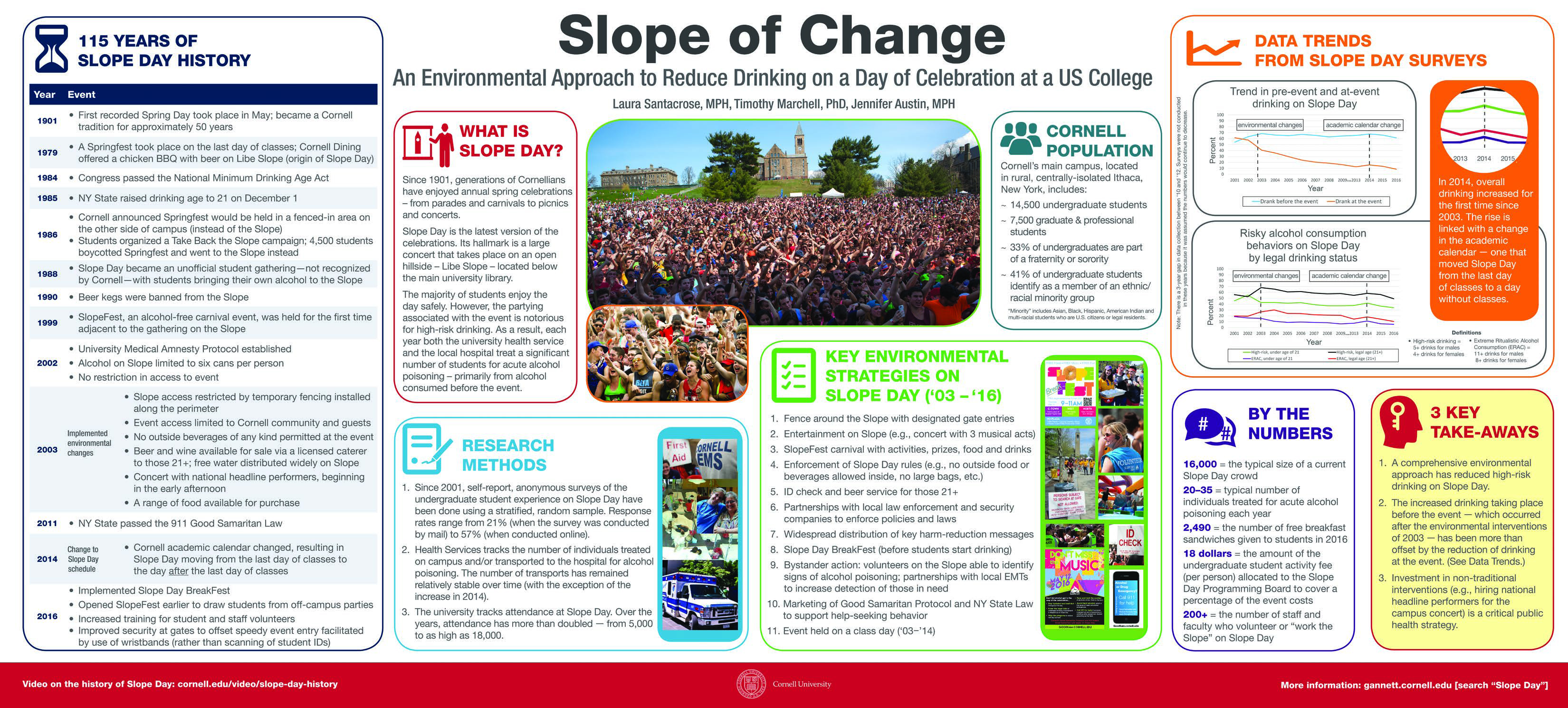
View our "Slope of Change" poster for a snapshot of our environmental approach to reducing high-risk drinking on Slope Day. You may download the PDF here (CU NetID required), or contact us for a copy.
AOD Biennial Review
View Cornell University's 2022-2024 AOD Biennial Review.
More information
Please contact the Skorton Center for Health Initiatives at Cornell Health.