


Approach
In the news
Cornell Marks 20 Years of Hazing Transparency as 'Stop Campus Hazing Act' Becomes Law (Cornell Chronicle, 2/28/25)
As a Health Promoting Campus, Cornell University recognizes hazing as a serious public health issue that undermines belonging, well-being, and student success. Hazing encompasses a range of behaviors that place individuals at risk of physical, psychological, and emotional harm as a condition of joining or maintaining membership in a group. Its effects can be profound, long-lasting, and, in some cases, fatal.
Did you know?
- Hazing is prohibited by the Cornell Campus Code of Conduct, the Sorority and Fraternity Rights and Responsibilities, and New York State Law.
- Groups that haze may be subject to consequences imposed by their sponsoring departments.
- More information about hazing and campus prevention efforts is available by visiting the university's hazing website, hazing.cornell.edu.
Our campus approach
Cornell’s current approach aligns with StopHazing’s Strategic Prevention Framework at the national level and builds on decades of campus work, beginning with the formation of a Cornell Task Force on Hazing (2001). This foundation, along with key developments, is well documented in the Hazing Prevention Timeline published on the Hazing at Cornell website
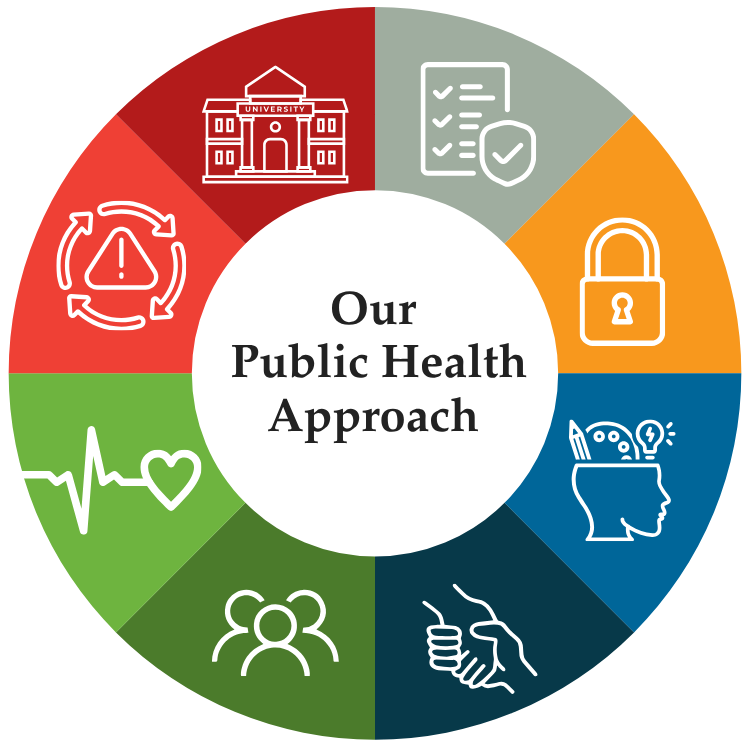
This page highlights Cornell’s comprehensive public health approach to hazing prevention—from leadership, policy, and education to help-seeking, enforcement, transparency, and support for affected individuals—while identifying opportunities for continued growth, reflecting Cornell’s commitment to continuous improvement and the ongoing work of building a safer, healthier campus community.
Institutional leadership | Policies & laws | Help-seeking & reporting | Educational initiatives | Positive Group Culture | Identification of people in need of care | Services & support | Enforcement
Skorton Center staff members provide institutional leadership and support for the university's hazing prevention initiatives.
Key initiatives
The following examples, while not comprehensive, illustrate the application of our public health approach to hazing prevention and response. Together, they emphasize creating conditions that support health and well-being while building the knowledge, skills, resources, and systems needed to address related challenges.

- Visible leadership statements: Online messages from senior university officials and student leaders affirm Cornell’s commitment to preventing hazing and articulate the values that guide its comprehensive approach.
- Research-informed strategies: Cornell uses campus and national data to identify prevention priorities, evaluate progress, and continuously strengthen its policies, educational initiatives, and prevention strategies. The university has participated in national hazing research led by StopHazing since 2013 and has conducted multiple campus surveys—including MASCOT, the Cornell Undergraduate Experience (CUE) Survey, and the 2026 National Study of Student Hazing— to inform its work.
- Hazing at Cornell website: The university’s central hub for hazing prevention brings together educational resources, reporting options, policies, support services, and decades of published violations and sanctions.
- Health Promoting Campus alignment: Cornell advances a whole-campus approach to belonging, connection, and well-being, recognizing that fostering healthy communities is fundamental to preventing hazing and other forms of harm.
- Beyond compliance: Staff from Public Safety, Risk Management, Student & Campus Life, University Relations, and Weill Cornell Medicine collaborated to ensure Cornell’s compliance with the federal Stop Campus Hazing Act. In 2026, that work will expand to advance an integrated public health approach to preventing and reducing harm across hazing, sexual violence, alcohol and other drugs (AOD), and mental health.

- Stop Campus Hazing Act: As of June 2025, the federal Stop Campus Hazing Act required all colleges and universities to implement comprehensive hazing policies, report incidents, and create transparency reports to enhance campus safety and accountability
- Hazing Policy Statement: Cornell’s hazing definition and reporting options (developed in 2001 and updated in 2021) were first published in its Campus Code of Conduct (now the Student Code of Conduct) and are included in the Hazing Policy Statement published in Cornell’s Annual Security Report.
- Good Samaritan Protocol (Good Sam): AOD misuse—whether or not it’s involved in hazing—remains a significant risk to student health and can be fatal. Good Sam protects both the person who calls and the person needing medical attention from student conduct and legal consequences for underage drinking, other drug use, or disorderly conduct. [See goodsam.cornell.edu.]
- Greek organizations: In 2012, the new member process for Interfraternity Council fraternities and Panhellenic Council sororities was shortened from eight to four weeks as a strategy to reduce opportunities for hazing.
- Athletic teams: Cornell’s Student-Athlete Handbook and Student-Athlete Rights and Responsibilities prohibit hazing, as defined in the Student Code of Conduct.

- Reporting: Members of the Cornell community can report hazing concerns online or through key campus resources (e.g., Public Safety, the Dean of Students). Online reports may be submitted anonymously.
- Cornell Police Silent Witness Program: Members of the Cornell community can anonymously report any non-emergency criminal or suspicious activity, including violations of the Student Code of Conduct.
Transparency: Information about hazing-related violations by student organizations has been displayed on Cornell’s hazing website since the 2004–2005 academic year, allowing students to make informed decisions about membership for over two decades.
Beginning Fall 2025—in accordance with the federal Stop Campus Hazing Act—reports published also include a Transparency Report with key actions in the response process, including the date(s) of the alleged incident, initiation of the investigation, conclusion of the investigation with findings, and notification of the outcome to the organization. These reports promote transparency and accountability while helping the campus community better understand the university’s response to hazing.
Annual Security Report (ASR): While the university’s Transparency Report includes descriptions of the groups found to be responsible for hazing, statistics of Clery-reportable incidents of hazing reported to Campus Security Authorities or to local law enforcement agencies—including reports with unsubstantiated allegations—will be included in the ASR prepared by Cornell University’s Clery Compliance Office, beginning fall 2026.

- Bystander intervention training: A video and workshop called Intervene equip students to recognize signs of distress and take appropriate action. One scenario depicts a student submitting a report of hazing on behalf of his roommate.
- Integrated prevention education: The Skorton Center for Health Initiatives offers educational programs on alcohol and other drugs (AOD), helping a friend in distress, sexual violence prevention, and hazing, reflecting the interconnected nature of these topics. Programs are available for students and, upon request, for staff, faculty, and campus groups.
- Social norms campaign: Cornell’s hazing prevention campaign uses campus-specific data to correct misperceptions about peer attitudes and behaviors related to hazing, helping reinforce healthy social norms and reduce pressure to engage in harmful practices.
- Hearing & Review Panel Training: Students, staff, and faculty who serve on the university panel are required to complete annual training on hazing. Panel members then apply this knowledge during the hearing and appeal processes.
- Hazing fact sheet collection: A series of online resources addressing topics such as alcohol and hazing (“liquid bonding”), supporting a friend, evaluating group membership, and the Hazing 5Rs Exercise for building traditions and group cohesion without hazing. (See hazing.cornell.edu/education/hazing-fact-sheet-collection.)

- Cornell Outdoor Education (COE): Customized experiences—from team-building activities to multi-day leadership expeditions—help groups build trust, strengthen relationships, and create cultures of belonging.
- New member training: Educational programs for student leaders responsible for welcoming new members emphasize healthy group dynamics, belonging, positive traditions, and hazing prevention. Trainings are offered to fraternities and sororities, professional fraternities, varsity athletics, and other student organizations.

- Cornell Health staff: Staff receive resources at least once a year to help identify signs of hazing as well as supportive resources for students.
- Student of Concern referrals: Any member of the Cornell community who is concerned a student has been hazed can connect with Student Support and Advocacy Services (SSAS) to coordinate follow-up support.
Residential staff: Live-in student and professional staff in Housing & Residential Life and the West Campus House System identify concerns, support residents, and connect students with campus resources. - Residential staff: Live-in student and professional staff in Housing & Residential Life and the West Campus House System identify concerns, support residents, and connect students with campus resources.

The Hazing at Cornell website outlines departments and resources across campus that collaborate on hazing prevention and response. The following resources are available to support the health and well-being of students who have been hazed:
- Victim Advocacy Program: Students can seek confidential support from advocates regarding harmful, threatening, or violent incidents they have experienced, including situations in which hazing played a role.
- Cornell Health clinical support: Hazing can affect physical health, mental health, and overall well-being for both those who experience hazing and those who participate in hazing others. Cornell Health provides integrated clinical care for students, including for those who have been harmed by hazing.

Cornell’s Office of Student Conduct and Community Standards, Division of Public Safety (including the Cornell University Police Department), Sorority and Fraternity Life, Physical Education and Athletics, and Campus Activities work together to address reports of hazing.
Appropriate offices ensure consistent enforcement of university policies and applicable state and federal laws.
More information
Questions about this content may be directed to the Skorton Center for Health Initiatives at skortoncenter@cornell.edu.